If your team is new to risk-based frameworks, here’s what that means and how to incorporate it into your NIST SP 800-171 and CMMC strategy.
What Is Risk-Based Thinking?
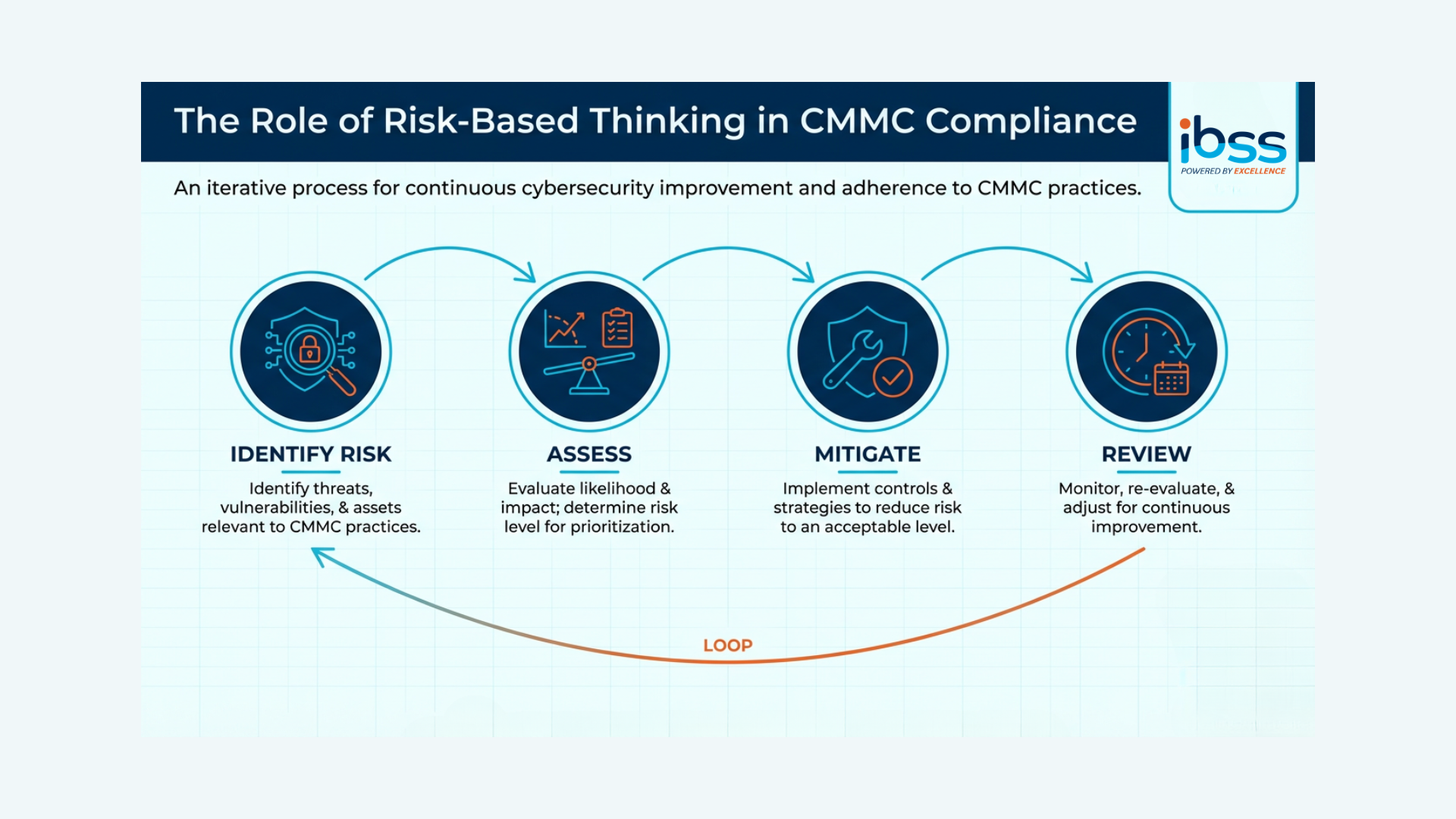
Risk-based thinking is a proactive approach to cybersecurity. Instead of reacting to threats after the fact, you assess which assets and data are most critical, and which threats are most likely to compromise them.
In the context of CMMC, it means evaluating:
- Where Controlled Unclassified Information (CUI) lives in your systems.
- What threats or vulnerabilities could compromise that data.
- How likely and how damaging those risks would be.
- What controls are most important to mitigate those risks.
This mindset is built into many of the practices and requirements under NIST SP 800-171, and becomes even more important when preparing your System Security Plan (SSP) and Plan of Action & Milestones (POA&M).
Why Risk-Based Thinking Matters for CMMC
Risk-based thinking helps organizations:
- Use resources efficiently
- Prioritize high-impact cybersecurity requirements
- Meet documentation and assessment expectations
- Respond to evolving threats
- Improve compliance audit outcomes
If you approach CMMC as a rigid checklist, you may struggle during your C3PAO assessment. But if you can demonstrate that your organization understands its risks and has taken steps to manage them, you show maturity and readiness.
Examples of Risk-Based Thinking in Practice
Here’s how risk-based thinking shows up in CMMC compliance:
- Access Control Decisions
- You limit access to CUI based on user roles and risk, not convenience.
- “Only users with a business need should access sensitive data.”
- System Boundaries
- You identify which systems are in-scope and protect them accordingly.
- “We isolate systems with CUI from general-use environments.”
- Security Prioritization
- You patch high-risk vulnerabilities first, even if other tasks are pending.
- “We prioritize controls that reduce the highest risks to mission-critical data.”
- Tailored Policies and Procedures
- You create policies based on your work environment, not generic templates.
- “Our incident response plan reflects the real risks our organization faces.”
How to Apply Risk-Based Thinking to Your CMMC Prep
Here’s where to start:
- Perform a Risk Assessment
- Document where CUI exists, the systems it touches, and the threats it may face.
- Use that to guide your SSP and POA&M.
- Define System Boundaries
- Clearly define what’s in and out of scope for CMMC. This helps focus your effort on areas that matter most.
- Prioritize Requirements Implementation
- Not all requirements carry the same weight. Prioritize based on business impact and likelihood of exploitation.
- Update Regularly
- Cyber risks evolve. Risk-based thinking means revisiting your security posture and making improvements regularly.
Compliance That’s Built to Last
A checkbox mindset might get you through a self-assessment but it won’t help you grow or stay compliant over time. Risk-based thinking is how successful defense contractors build scalable, resilient cybersecurity programs that meet CMMC Level 2 and DoD expectations.
Book your CMMC Readiness Call today or email us at CMMCC3PAO@ibsscorp.com to start the path toward certification with a team that knows the process inside and out.
About IBSS
Since 1992, IBSS has provided transformational consulting services to the Federal defense, civilian, and commercial sectors. Our services include cybersecurity and enterprise information technology, environmental science and engineering (including oceans, coasts, climate, weather, and satellite), and professional management services.
Our approach is to serve our employees by investing in their growth and development. As a result, our employees bring greater capabilities and provide an exceptional level of service to our clients. In addition to creating career development opportunities for our employees, IBSS is passionate about giving back to the community. We strive to leave something better behind for the next generation.
We measure our success by the positive impact we have on our employees, clients, partners, and the communities we serve. Our tagline, Powered by Excellence, is a recognition of the employees that make up IBSS and ensures we deliver results with quality, applying industry best practices and certifications. Read more About Us.
Keywords: CMMC, C3PAO, DoD Requirements, NIST SP 800-171, Cybersecurity