Here’s what you need to know about developing a CMMC-ready POA&M.
What Is a POA&M?
A POA&M outlines deficiencies in your current cybersecurity posture and details the steps your organization will take to remediate them. Under CMMC 2.0, organizations aren’t permitted to have any active POA&Ms and obtain the CMMC Level 2 certification. Under CMMC 2.0, organizations are eligible for conditional certification for select NIST SP 800-171 requirements, and you can develop a POA&M for those requirements.
However, as inferred above, not all controls are eligible for a POA&M. And, an incomplete or vague POA&M will likely result in a failed assessment.
Why the POA&M Matters for CMMC Level 2
At Level 2, CMMC assessments are aligned with NIST SP 800-171, which includes 110 requirements. If you’ve addressed 100 of them and have a detailed POA&M explaining how and when you’ll address the remaining 10 (as allowed), you may still achieve conditional certification, but only if your POA&M meets strict criteria.
That means your POA&M can’t just list “fix control later.” It must demonstrate:
- A clear understanding of what’s missing.
- A realistic and resourced plan for remediation.
- A 180-day remediation timeline and accountability structure.
What to Include in Your POA&M
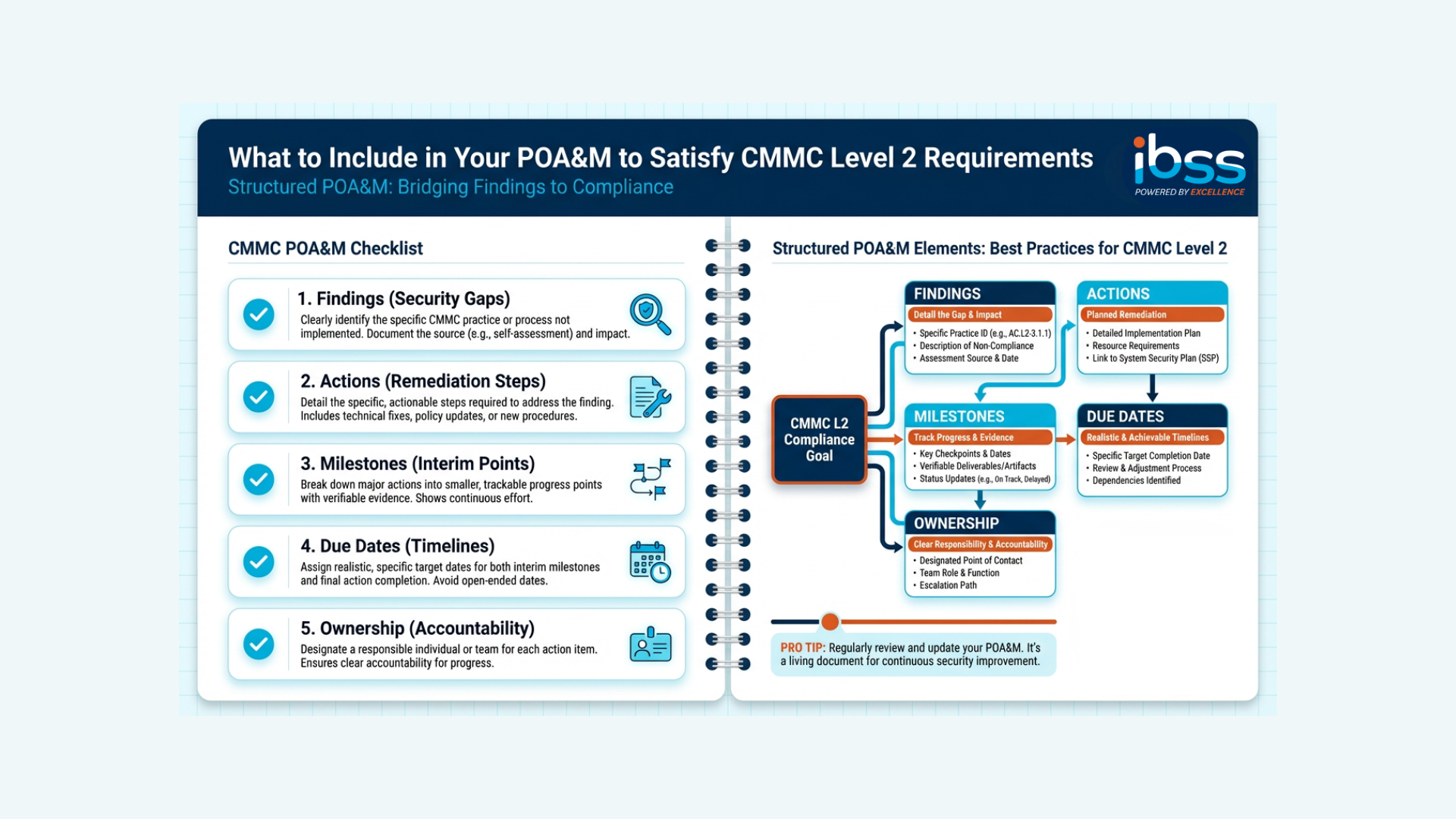
Each open item in your POA&M should include the following:
- Control Reference
- Cite the specific NIST SP 800-171 control (e.g., 3.1.1 for Access Control)
- Description of Deficiency
- Clearly explain the gap or issue that prevents full implementation.
- Avoid generic language. Instead, be specific to your environment.
- Planned Remediation Actions
- Detail the exact steps your team will take to address the issue.
- Include technology, policy, or training changes needed.
- Milestones and Timeline
- Set target dates for each milestone.
- Make sure timelines are realistic and reflect actual work capacity.
- Resources Assigned
- Identify the staff, departments, or third-party partners responsible for each action.
- Risk Level (Optional)
- Help prioritize work by tagging each gap with a low/medium/high risk rating.
How IBSS Can Help You Develop a Compliant POA&M
Developing a POA&M that satisfies CMMC Level 2 is about showing that your organization has a realistic, resourced, and risk-aware plan to close cybersecurity gaps, something assessors and contracting officers take seriously.
At IBSS, we help DoD contractors:
- Identify and prioritize gaps through a readiness assessment.
- Develop complete, detailed POA&Ms aligned with NIST SP 800-171.
- Link remediation steps to your System Security Plan (SSP).
- Track progress toward full compliance and certification.
Book your CMMC Readiness Call today or email us at CMMCC3PAO@ibsscorp.com to start the path toward certification with a team that knows the process inside and out.
About IBSS
Since 1992, IBSS has provided transformational consulting services to the Federal defense, civilian, and commercial sectors. Our services include cybersecurity and enterprise information technology, environmental science and engineering (including oceans, coasts, climate, weather, and satellite), and professional management services.
Our approach is to serve our employees by investing in their growth and development. As a result, our employees bring greater capabilities and provide an exceptional level of service to our clients. In addition to creating career development opportunities for our employees, IBSS is passionate about giving back to the community. We strive to leave something better behind for the next generation.
We measure our success by the positive impact we have on our employees, clients, partners, and the communities we serve. Our tagline, Powered by Excellence, is a recognition of the employees that make up IBSS and ensures we deliver results with quality, applying industry best practices and certifications. Read more About Us.
Keywords: CMMC, C3PAO, DoD Requirements, NIST SP 800-171, Cybersecurity